EV Charger Installation Cost Guide NJ 2026: What Monmouth County Homeowners Should Budget

Expert Deck Staining and Sealing: Protecting Your Investment in 2026
March 25, 2026
How Much Does a Handyman Cost Per Hour in NJ 2026? Real Rates for Monmouth County
April 13, 2026
Installing a Level 2 EV charger at your West Long Branch home typically costs between $800 and $3,000 in 2026 — and with the federal 30% tax credit (up to $1,000) expiring June 30, 2026, acting now can save you real money on the project.
If you’ve been waiting to set up home charging for your electric vehicle, April is the right time to price it out. Tax refund season coincides with the last window before the federal charger credit disappears, and Monmouth County electricians are booking fast.
Key Takeaways
- Level 2 (240V) EV charger installation in Monmouth County runs $800–$3,000 total, including equipment ($500–$1,200) and electrician labor ($300–$1,200).
- The federal 30C tax credit gives you 30% back, up to $1,000 — but expires June 30, 2026.
- New Jersey’s Charge Up NJ program adds a $250 state rebate per Level 2 charger, and PSE&G offers up to $1,500 in make-ready credits for smart chargers.
- Homes with 100-amp panels may need a panel upgrade to 200-amp service before EV charger installation, adding $1,200–$4,500 to the total.
- A dedicated 240V circuit for an EV charger always requires a permit under the NJ Uniform Construction Code — DIY installation is not legal for this scope of work.
What You’re Actually Paying For: Cost Breakdown
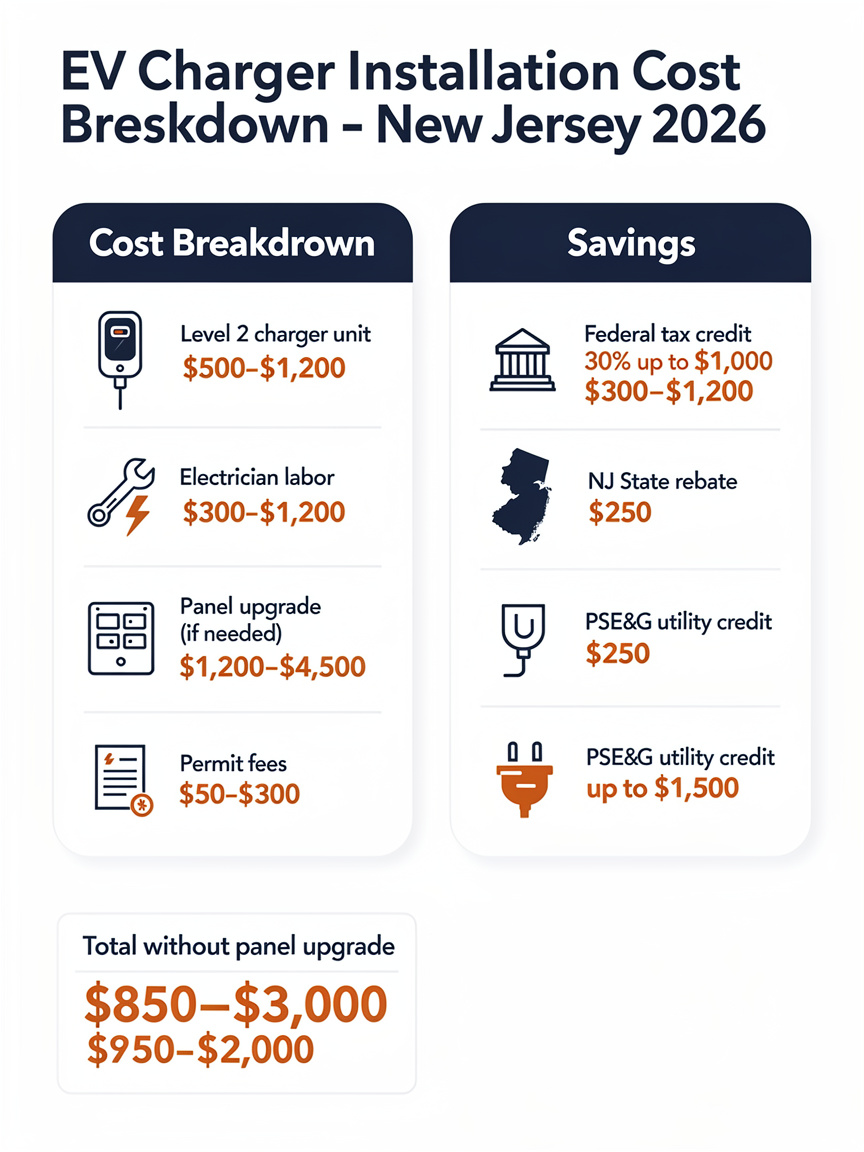
An EV charger installation isn’t just buying a box and plugging it in. The total project cost breaks down into four distinct components, and the charger unit itself is usually the smallest piece.
| Cost Component | Typical Range (NJ 2026) | What It Covers |
|---|---|---|
| Level 2 charger unit (equipment) | $500–$1,200 | The charging hardware itself (ChargePoint, Wallbox, Grizzl-E, etc.) |
| Electrician labor and materials | $300–$1,200 | Wire run from panel, breaker installation, conduit, mounting, testing |
| Electrical panel upgrade (if needed) | $1,200–$4,500 | Upgrading from 100A to 200A service to handle the additional load |
| Permit and inspection fees | $50–$300 | Municipal electrical permit + rough/final inspection |
| Total (no panel upgrade needed) | $850–$3,000 | Equipment + labor + permit |
| Total (with panel upgrade) | $2,050–$7,500 | Equipment + labor + panel upgrade + permit |
Most newer homes in West Long Branch built after 1990 already have 200-amp service. If your home runs on 100-amp service and you’re already pushing capacity with central AC, an electric dryer, and a range, the panel upgrade becomes necessary before adding a 40-amp EV charger circuit.
Level 1 vs. Level 2 Charging: Do You Actually Need a Level 2?
A Level 1 charger plugs into any standard 120-volt outlet in your garage. They typically come included with your EV purchase. The catch? Level 1 charging adds about 3–5 miles of range per hour. For a car with a 250-mile battery, that’s 50–80 hours for a full charge. If you’re commuting 30 miles a day in Monmouth County, Level 1 might keep up — barely.
A Level 2 charger runs on 240 volts and adds 15–40 miles of range per hour depending on the charger’s amperage. Most EV owners plug in overnight and wake up to a full or near-full battery. That convenience is what makes Level 2 the standard choice for home charging.
| Feature | Level 1 (120V) | Level 2 (240V) |
|---|---|---|
| Charging speed | 3–5 miles of range/hour | 15–40 miles of range/hour |
| Full charge (250-mile battery) | 50–80 hours | 6–16 hours |
| Equipment cost | Included with most EVs | $500–$1,200 |
| Installation cost | $0 (uses existing outlet) | $300–$1,200 (electrician) |
| Circuit required | Standard 15A or 20A | Dedicated 40A–60A circuit |
| Permit required | No | Yes (NJ UCC) |
If you drive more than 30 miles per day, have a plug-in hybrid with a small battery, or want the flexibility to charge quickly before a road trip, Level 2 is the clear answer.
Available Rebates and Tax Credits — Act Before They Expire
Here’s the financial upside most New Jersey EV owners miss: stacking the federal tax credit, state rebate, and utility incentive can reduce your net cost by $1,750 to $2,750.
Federal Tax Credit: 30% Up to $1,000 (Expires June 30, 2026)
The IRS Section 30C credit covers 30% of the total project cost — including the charger unit, electrician labor, wiring, panel work, and permits — capped at $1,000 for residential installations (IRS details). On a $2,000 installation, that’s a $600 tax credit. On a $3,500 project with panel work, you’d hit the $1,000 cap.
New Jersey State Rebate: $250 via Charge Up NJ
The Charge Up NJ program offers a flat $250 rebate per Level 2 charger for residential installations.
PSE&G Utility Credit: Up to $1,500 for Smart Chargers
If you’re in the PSE&G service area (which covers most of Monmouth County), the utility offers up to $1,500 per charger in make-ready infrastructure credits for qualifying smart chargers.
| Incentive | Amount | How to Claim | Deadline |
|---|---|---|---|
| Federal 30C Tax Credit | 30% up to $1,000 | IRS Form 8911 on tax return | June 30, 2026 |
| Charge Up NJ State Rebate | $250 | Application through NJ BPU | Ongoing |
| PSE&G Smart Charger Credit | Up to $1,500 | Application through PSE&G | Ongoing |
| Maximum total savings | Up to $2,750 |
On a $2,500 installation, stacking all three incentives could bring your net cost down to as little as $250–$750. That’s why timing matters — the federal credit is expiring mid-year.
What Drives the Price Up or Down
Not every EV charger installation is the same. Here are the variables that move the needle most:
Distance from panel to charger location
The shorter the wire run, the lower the cost. If your electrical panel is in the garage and you’re mounting the charger on the garage wall, you’re looking at the low end — maybe $300–$500 in labor and materials. If the panel is in the basement and the charger goes on the driveway-side exterior wall, that wire run could add $200–$600 in copper wire and conduit.
Amperage of the charger
A 32-amp charger needs a 40-amp breaker and 8-gauge wire. A 48-amp charger needs a 60-amp breaker and 6-gauge wire. Most homeowners are well-served by a 32- to 40-amp charger, which covers 95% of overnight charging needs.
Panel capacity
This is the wildcard. If your panel is already near capacity, adding a 40-amp EV circuit means either upgrading the panel or doing a load management assessment. In older West Long Branch homes built before 1980, panel upgrades are common.
Smart vs. standard charger
Smart chargers (Wi-Fi connected, app-controlled) cost $100–$300 more than basic models but qualify for the PSE&G utility credit. If you’re in PSE&G territory, the smart charger often pays for itself through the utility incentive.
The Installation Process: What to Expect
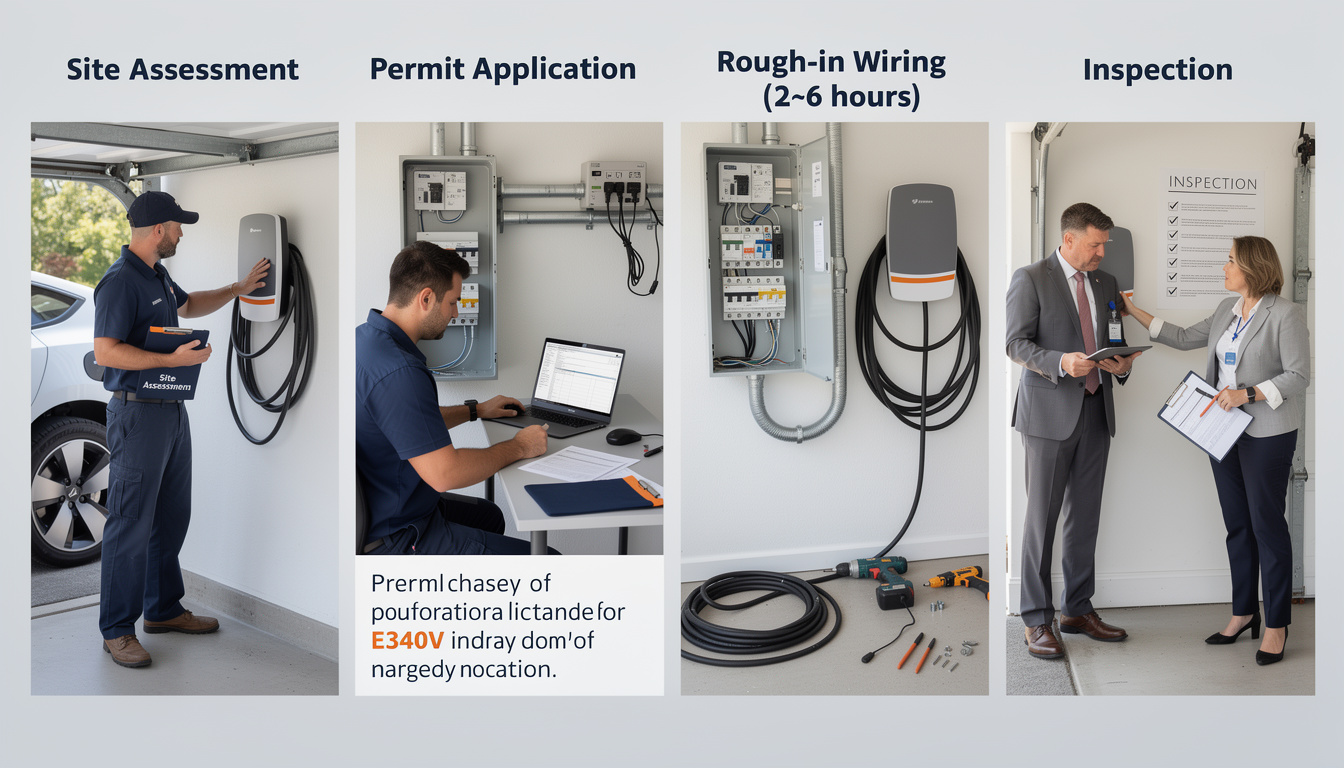
A typical Level 2 EV charger installation in Monmouth County follows this sequence:
1. Site assessment (30–60 minutes)
An electrician evaluates your panel capacity, maps the wire route, and confirms the mounting location. If you’re not sure about your panel’s readiness, our electrical services in West Long Branch team can assess it first.
2. Permit application (1–5 business days)
Your electrician files the electrical permit with the West Long Branch Construction Office. The permit fee is based on device count and amperage per NJ UCC rules.
3. Rough-in wiring (2–6 hours)
The electrician runs the wire from the panel to the charger location, installs the breaker, mounts the charger unit, and terminates all connections.
4. Inspection and sign-off (1–2 weeks after rough-in)
A municipal electrical inspector verifies that the installation meets NEC standards. They check wire sizing, breaker rating, grounding, GFCI protection, and proper labeling.
5. Utility coordination (if required)
If the installation involves a meter upgrade or service entrance work, PSE&G may need to coordinate the final connection.
EV Charger Brands Worth Considering in 2026
| Brand | Model | Amperage | Smart Features | Equipment Cost |
|---|---|---|---|---|
| ChargePoint | Home Flex | 16–50A | Wi-Fi, app control, scheduling | $550–$700 |
| Wallbox | Pulsar Plus | 32–48A | Wi-Fi, Bluetooth, compact design | $500–$750 |
| Grizzl-E | Classic | 32–40A | Basic (no Wi-Fi), rugged build | $400–$550 |
| Emporia | Vue Smart | 32–48A | Energy monitoring, app control | $400–$550 |
| Tesla | Wall Connector | 48A | Wi-Fi, Tesla ecosystem, universal J1772 adapter | $450–$550 |
For most Monmouth County homeowners, the ChargePoint Home Flex or Wallbox Pulsar Plus hits the sweet spot of price, features, and PSE&G smart charger eligibility.
Do You Need an Electrician, or Can a Handyman Handle It?
A handyman with an NJ Home Improvement Contractor (HIC) registration can mount the charger unit on the wall and run surface conduit in some cases. But the panel connection — installing the new breaker and tying the circuit into your electrical service — must be done by a licensed electrical contractor in New Jersey.
In practice, most homeowners hire an electrician for the entire job. It’s faster, it’s fully permitted, and the electrician takes responsibility for code compliance from start to finish.
Handyman Near Me NJ provides electrical assessments and can coordinate the full installation scope for your West Long Branch home. If you’re not sure whether your panel has the capacity for an EV charger, our electrical services in West Long Branch team can evaluate your setup and give you an honest answer before any work begins. We’re available 24/7 and offer free estimates on all projects.
Frequently Asked Questions
1. How much does it cost to install an EV charger in New Jersey?
Level 2 EV charger installation in New Jersey typically costs $800 to $3,000 total, including equipment ($500–$1,200), electrician labor ($300–$1,200), and permit fees ($50–$300). If your home needs a panel upgrade from 100A to 200A, add $1,200–$4,500.
2. Is there still a federal tax credit for EV charger installation?
Yes, but it’s expiring. The federal 30C tax credit gives you 30% back, up to $1,000, for property placed in service by June 30, 2026.
3. Do I need a permit to install an EV charger in Monmouth County?
Yes. Installing a dedicated 240V circuit always requires an electrical permit under the New Jersey Uniform Construction Code. Your licensed electrician pulls the permit and schedules the required inspections.
4. Can I install an EV charger myself in New Jersey?
Only if you live in a single-family, owner-occupied home, pull a permit yourself, and personally do all the work. However, adding a new 240V circuit typically requires a licensed electrician in most NJ municipalities.
5. How long does an EV charger installation take?
A straightforward installation typically takes 2–6 hours. More complex runs or properties needing panel work can take a full day. Permit inspection adds 1–2 weeks.